"AND EVERYTHING IN BETWEEN"
☻
"AND EVERYTHING IN BETWEEN" ☻
Writing from Columbus, Ohio
A new kind of filmmaker
Originally posted on Svbtle.
That’s my tagline on Svbtle. I needed to come up with something that felt interesting. That was the first thing that came to me. Then I really started thinking about it.
First, I should make something clear: Everything is a remix. I don’t intend to insinuate that I have new, secret ideas. I’m not even sure I have something brilliant to say. Not yet anyway.
But I do feel like I’m doing something that not everyone does. I’m being honest. I’m not only showing you the glamorous bits.
I’m living proof that it may take posting dozens of videos on Vimeo before you make something that gets over 100,000 views. Maybe it’s another 10 or 20 projects before your next video hits 50,000 views. With enough persistence and hard work, you can get there.
Ideas are announced and scrapped in a matter of weeks. It’s hard killing something you love.
Think of a person that inspires you. Would you have more or less admiration for them if you saw all their bad ideas, too?
I’m not sure where this road will take me. Hopefully I can continue telling stories for a very long time. Hopefully I get better at it along the way. But if I can leave something behind, something that shows real challenges of being a creative, a world where not everything is handed to me, and maybe the first iteration of the idea isn’t so brilliant… if that helps just one person that comes down this path after me, then I think it was worth it.
If nothing else, it’ll help me remember where I came from.
Say something brilliant
Originally posted on Svbtle.
Even on a platform like Svbtle that strips away many of the bells and whistles, there’s an inherent pressure when you see the text Write post here. It might as well read: Say something brilliant.
Everyone wants to write the next great blog post that gets a million hits. But you’re conditioned to feel that if you don’t have a strong opinion, something that you’d fight to the grave defending, why bother? Do your words even matter?
That conditioning does make some sense. Everyone is so busy in today’s world – at least, that’s what I keep hearing repeated over and over, despite how much time people spend on Facebook and Twitter every day – that if you don’t have indisputable value to add, you’re not worth anyone’s time.
This isn’t another post celebrating bad ideas. I’m tired of ideas.
This is a post advocating you to not take things so seriously.
An entrepreneur doesn’t always have to be building the next billion dollar company. A project you enjoy that pays the bills is just fine, too.
If you’re a filmmaker, you don’t have to try to be the next Christopher Nolan. Your first movie doesn’t have to be Memento – it wasn’t his first, either.
This isn’t to say you should shoot low and sacrifice quality or effort. It’s just a reminder that it’s ok to not always be prolific. Don’t waste time trying to be the next Mark Zuckerberg, be the first you. (Now that’s a Hallmark card if I’ve ever written one.)
Sometimes being entertained is all that matters. There’s room in this world for films like Pacific Rim and Upstream Color to coexist. Unwinding six seconds at a time on Vine is a great way to end the day, even if the app doesn’t have a billion users.
One thing I find is the more I write, the more creative I feel. Ideas flow a little more easily when I’m regularly in the mindset of processing and recording thoughts. But it’s intimidating when you launch a blank document. There’s pressure when you feel like every post needs to be the next hot thing that gets tweeted by everyone.
Sometimes it’s ok to just say something, anything. The prolific stuff will come later.
You should follow me on Twitter here. I’ve got 140 characters to say something brilliant, no pressure.
Predict or die
On Apple, Nokia, BlackBerry, and Nintendo.
Initially, I titled this post “Adapt or die,” but I decided “Predict or die” is more appropriate. I’ll get to that in a moment.
There have been a lot of articles written about Apple, Nintendo, and BlackBerry with a common theme that if the companies don’t adapt to the changing landscape of consumer technology, they will die. You could say Nokia is already there, with their devices unit being bought by Microsoft for $7.2 billion.
People have been calling for Apple’s demise since 1984. For quite awhile, they looked to be correct. Then Steve Jobs.
But maybe the iPhone is losing a bit of its shine. The thought is that if Tim Cook and Co. don’t develop the next big hit soon, someone else will. That’s not unfair thinking. If Apple had stuck with the iPod as their flagship device for another five years, we would probably be talking about them in the same way we talk about Nokia or BlackBerry.
Tuesday morning in Cupertino, Apple will unveil whatever is next in the world of iPhone. Some of the rumors will have been true, while Apple will almost certainly have one or two tricks up its sleeve. It will impress some and disappoint others. Such is life when you’re the most valuable technology company in the world.
That doesn’t mean there isn’t truth in the thinking that Apple needs to change the game it’s playing. Or better yet, take someone else’s game and change it. That’s what Apple does best – the iPod wasn’t the first MP3 player, the iPhone wasn’t the first smartphone, and the iPad wasn’t the first tablet. But they all changed the game. Listening to music wasn’t about specs, it was about ease of use. Smartphones weren’t about tiny keyboards that mimicked a desktop interface, they were about a new form of computing in your pocket. And tablets weren’t about styluses…
So, that brings me back to the title of this post, “Predict or die.” It’s not simply about adapting. By now, Nokia has adapted in many ways. So has BlackBerry. Yet, both companies are still largely playing the game of yesterday. They’re competing with the 2007 Apple, not the 2013 Apple. By the time the next line of Microsoft Lumia-whatever-they’re-calling-it is released, they’ll be up against the 2014 Apple. (If Apple comes up with the next big hit between now and then, that’s a big problem for many. It’ll be a problem for Apple if someone not only gets there first, but far better.)
From Financial Review, “The Nokia insider who knows why it failed warns Apple it could be next” –
In an honest assessment, he laments Nokia’s missed opportunities. It had working prototypes for 8-inch tablet computers years before the iPad emerged, toyed with touch screens before Apple “invented” them and let its dominance slip by seeking to protect what it had.
“I look back and I think Nokia was just a very big company that started to maintain its position more than innovate for new opportunities,” Nuovo says.
“All of the opportunities were in front of them and Nokia was working on them, but the key word is a sense of urgency. While things were in play there was a real sense of saying ‘we will get to that eventually.’”
He gets it, but he still doesn’t really get it. It doesn’t matter who did it first. If Nokia had made a touchscreen phone in 2006, Steve Jobs wouldn’t have scrapped the plans for the iPhone. The 2006 Nokia touchscreen phone would have sucked. The bottom half would have had a keyboard. You probably would’ve needed a stylus. The software would have been garbage.
You need to see what’s next before anyone else and execute on it. Nokia focus tested it to death. It’s not about one piece of technology, it’s about the entire experience. It’s about making a promise to your users to make The Best Possible Thing™, and delivering on that.
Maybe Microsoft sees that and that’s why they bought Nokia. Maybe it will give them a fighting chance. Or maybe by the time they make any meaningful improvements to Windows Phone and its ecosystem, it’ll already be three or four years too late.
BlackBerry’s tried it. They are already the most Apple-like phone maker, and they couldn’t recapture the market before it was too late. They’re playing the game from 2009, before Android got its stuff together. They’re not really playing to win. They’re playing to be third or fourth at best.
If BlackBerry switches to Android, makes no more than two phone models (BlackBerry Classic and BlackBerry Touch, I’d call them), goes all-in on cross-platform BlackBerry Messenger, and kills (or sells) everything else, could they make it out the other end? Their days of competing with Apple or Samsung are over, but they could knock off HTC and other Android hopefuls. They probably won’t though, because by the time they do anything it’ll be late 2014.
Side note: What if Microsoft bought BlackBerry, put them in charge of Microsoft enterprise mobile and Nokia in charge of Microsoft consumer mobile? Steve Ballmer clearly has no problem paying ridiculous sums for questionable companies.
What does Nintendo have to do with all of this? A lot, actually. They’re next. Nintendo is saying the same thing BlackBerry (RIM at the time) and Nokia said half a decade ago. “We’ve got time. We’ve got money. We’ll figure it out.”
Nintendo should care about Nokia and BlackBerry, because along with the iPhone and its Android counterparts, that’s where people are spending their time. And money. The 3DS does look just fine as a gaming device. But am I going to spend $200 on that or the next iPhone?
MG Siegler writes –
You’re profitable and a healthy business until you’re not. The mistake often made is to think that dramatic shifts in business can’t happen quickly. They can happen very quickly. And Nintendo is in a market that is experiencing such a shift.
Nintendo can do whatever they want to do. The problem is that they aren’t. They’re iterating on hardware from 2004 (Nintendo DS) and 2006 (Nintendo Wii). I mean, come on. It’s 2013. How is the 3DS really different from the DS?
Nintendo is experiencing the same failure to act that Nokia did in 2007. The same thing BlackBerry did in 2009. “We’re fine.”
You don’t have to invent the future. You just have to figure out what consumers really want. Consumers are telling Nintendo exactly what they want. Consumers aren’t buying a 3DS, they’re buying an iPad.
This was Steve Jobs’ genius. He knew what you wanted before you did. Even if you’ve never used an iPhone, if you’re using an Android, Windows Phone, or modern BlackBerry, you’re using something he inspired. No, Steve didn’t invent the touchscreen, or the app, but he correctly predicted what users really wanted out of their phone. Remember the original Android concept?
Nintendo could put their games on iOS. Or they could just as easily make their next handheld a phone. (Please, not the N-Gage.) But they won’t. Not until it’s too late, anyway. Yeah, Mario Kart would sell on an iPhone in 2015 if Nintendo finally decides that’s the right move, but that’s not the point.
Two years from now, if Nintendo still doesn’t have an exciting plan for the future, they’re only about five years late. If they are in a position of giving in and putting their games on iOS as a means to prop up a dwindling console business, it’s the beginning of the end. If they’re proactive by putting their games on iOS while saying, “If you want a premium gaming device, we’ll be over here with the future of mobile,” they could have something.
But why would they do that? The 3DS is selling. They’ve got money. They’re fine.
Stop Blaming Technology (Blame Yourself)
Originally posted on Medium.
More and more people are coming online for the first time, using smartphones and tablets, and integrating technology in their lives in meaningful ways.
What would life be like without using the internet for a year? That’s what Paul Miller of The Verge set out to discover. Do you think you could do it? Do you think it would change your life?
Then Baratunde Thurston, formerly of The Onion, wrote about his 25-day unplugging at the end of last year.
You’ll read accounts like this, from Paul Miller:
…I was spotted by a man brandishing one of my own articles about leaving the internet. He was ecstatic to meet me. I had chosen to avoid the internet for many of the same reasons his religion expressed caution about the modern world.
“It’s reprogramming our relationships, our emotions, and our sensitivity,” said one of the rabbis at the rally. It destroys our patience. It turns kids into “click vegetables.”
And Baratunde:
I stopped next at a friend’s holiday party, where I engaged in conversation without once taking out my phone to see what Twitter had to say about my conversation. My mind left the party only when my body did, at about 2 in the morning.
He continues…
And the fact is, I maintained the same slow pace, the same sense of discovery that I enjoyed during that first week. There were movies, there were food trucks, there were friends, there was mulled wine. There was brief consideration of a mulled-wine food truck. Above all, there was an expansion of sensations and ideas.
Magical moments that could not have happened if he had a phone in his pocket.
There are countless articles and blog posts that tell variations of the same grim tale: A couple sitting at a dinner table, staring at their phones, together but alone. It certainly does happen, which I guess it why it’s always mentioned. But is it the problem?
My wife and I will be having our first baby soon. Very soon. (Oh man, this is happening pretty fast.) So I’ve been thinking a lot about how to incorporate technology into my son’s life and learning process. I still remember the first time I saw a child under two years old unlock an iPhone and launch an app.
In order to determine how to best use technology for his development, I have to take a look at how we use technology ourselves. It’s all related, and my choices will influence his choices.
Yet everything I read is how terrible technology is for us. How we spend too much time staring at screens and not talking to the people around us. And I think it’s all bullshit.
Thankfully, just yesterday I saw an article on The Verge by Ben Popper titled, “Is technology scrambling my baby’s brain?” It was one of the first pieces that felt balanced. And that’s one of its key takeaways: It’s all about balance.
I called Dr. Dimitri Christakis, director of the Center for Child Health, Behavior and Development at Seattle Children’s Research Institute. “Screens are purely a delivery mechanism. What parents should be focused on is the content,” he told me. A blanket ban on screens, he argued, doesn’t make sense. “I’m a member of the American Academy of Pediatrics, but I have to say, their statement about the effects of electronic media is clearly out of date.”
What matters, says Christakis, is the difference between passive and active consumption.
Technology and the internet have made our lives infinitely better. We’re able to connect with people thousands of miles away, take an online class, and look up any piece of information you could possibly imagine.
As with anything, when not used in moderation, it could be harmful to you or those around you. If you plop yourself (or your child) in front of a screen without engagement or interaction, that certainly could have negative effects. Still, the technology itself is not at fault.
Although I appreciate Baratunde’s brand of tongue-in-cheek humor, this point is similarly used by many to prove that life is just so much better without technology:
For lunch I frequented Chuko, where the server recommended the pork-belly ramen. This was not the Yelp.com server, mind you, but a human server who proclaimed, “Try the pork-belly ramen.” What an algorithm.
With or without a phone in our pocket, we can always talk to the person sitting next to us. There are many reasons we don’t: We value our friends’ opinions more, or we prefer to search thousands of opinions instead of just one, or maybe we just don’t feel like talking to anyone that day. The point being, there’s nothing about your phone that is controlling you. It’s simply a choice to leave it in your pocket during dinner.
All it takes is a little self-control.
It’s ok if you don’t have the self-control to always be perfect. Breaking a habit isn’t about quitting cold turkey. It’s not about pointing fingers at a problem and saying, “If this would just go away, life would be better.” Breaking a habit takes recognizing a pattern, and doing your best to alter it. You’ll have good days and bad days. But if you take a moment and think that you should put your phone away and chat with your friend, you’re already doing well. Listen to that voice enough and it will become your new habit.
Is “quitting the internet” for 25 days realistic for most people that aren’t privileged enough to have someone run their company for them while they’re gone? Probably not. Does it really address the problem of being addicted to checking every notification? Probably not.
I think blaming technology is one of those things that just feels good for people from time to time. It’s like blaming fast food for obesity. It doesn’t actually do anything to uncover the true issue. It doesn’t actually do anything to encourage better habits.
Stop blaming technology. Start blaming yourself. Try your best to recognize if you’re checking your phone too frequently, addicted to email, or not spending quality time with those you care about. Do something little every day to build better habits.
Don’t lock your phone in a drawer and proclaim your problems solved. Try turning off some of your notifications. Try not responding to work email during the weekends. Or just try putting it in your pocket more often.
Ant's Got It

Photo by Johnny Hochstetler
Every so often, great people connect with you and enable you to tell an important story. This was one of those times.
Anthony Jackson was just 22 when he passed away. He was the type of person who put a smile on everyone's face and made everyone around him a better person. He volunteered his time, was always there for a friend, and even became the youngest manager ever where he worked.
In preparing for this project, I talked to a few people who knew Anthony. Friends, family, and even someone who didn't know him personally all told the same story: He was special. And he was gone way too soon.
This was simultaneously one of the most difficult and one of the easiest projects I've ever produced. Difficult because of the circumstances with which we were producing the video, but easy because everyone around Anthony and the friends and family we interviewed were so eloquent and compassionate. You can really tell the profound impact he had on so many in just 22 short years. We all just wanted to make Anthony proud.
Together with Johnny Hochstetler, Zach Frankart, Emily Long, and in partnership with HOMAGE, we produced this short video for Anthony. I hope it is able to capture just some of his spirit.
We decided to film the piece in the style of what you might see on 30 for 30 or E:60. The Wellington School in Columbus, where Anthony played basketball in high school, generously offered the use of their gym. I wanted every shot to be thoughtful and with a purpose. People like Anthony deserve to be immortalized just like our sports heroes.
Telling stories that matter is what drives me every day. It's an honor to be a part of preserving another little piece of Anthony.

Support the JDRF in the fight against Type 1 Diabetes.
An update on Built in Cbus
When I first started Built in Cbus, my vision was grand in scope.
I wanted to build a creative community. I hoped not only to provide a platform for creatives and entrepreneurs to promote their work, but also to provide resources by way of mentorship, partnership, and other means. That would take a lot of time, and a lot of money.
So I wanted to start smaller. I didn't just want to start another blog. ("Who wants to read another blog?" He asks, as he writes this on his blog.)
I wanted to use my talent and passion for video to bring something unique to the city. With my good friend Zach Frankart and a few others, we started out doing interviews with five interesting people in Columbus. They were well received, and we pushed forward making more videos, mostly around downtown.
I wanted to build a platform where we could provide value to people starting businesses. Alongside informative interview or documentary style pieces, we would create short promos and behind the scenes pieces on businesses and events. We could build the site out around smaller communities within Columbus. This could lend to a greater sense of pride and connection with your neighbor, and allow us to get more granular in coverage that may not apply everywhere else. We could make t-shirts! The Short North Motorcycle Club was my personal favorite.
We did our thing for a little while, and at the same time let our imaginations run wild with where it could take us and the community. At a certain point, when trying to put together more content, I ran into something unfortunate.
No one wanted to truly partner with the site. Some people wanted free work, sure. But when it came to cross-promotion or developing a place where creatives can thrive, everyone else fell silent.
Built in Cbus is one of the reasons I'm so personally against doing free work. There is a time and place to work on passion projects. Almost every video you see on Built in Cbus was created for free, and we've never run any type of advertising. But when a business approaches you and wants you to invest your time, equipment, and expertise into making something used to promote their business (which, ideally, brings in more customers and makes them more money), it's just dirty and wrong.
It wasn't supposed to be about money. I mention it here because it was really disheartening to not find more people that wanted to foster a community. I wanted to help young creatives and entrepreneurs in ways that I haven't been helped.
I'm amazed that every day @builtincbus gets at least a half a dozen new Twitter followers. Maybe the account gets recommended when new users follow a lot of other prominent Columbus-based accounts, but we've hardly put out any true "Built in Cbus" content for a year.
When you look at Silicon Valley and companies like Instagram, Twitter, or any of the numerous popular blogs, you realize not everything has to have a business model. Not right away, anyway. That was my hope with Built in Cbus. I guess I was wrong.
I'm not shutting down the site. I moved it over to live as a part of my site 7 or 8 months ago because it didn't make sense to pay for separate hosting when I wasn't actively putting new content up every month. But the site still has value (and our work still gets its positive comments from time to time), and I'm not just going to throw that away. Maybe one day if I meet someone with deep pockets, we can fund some of the original ideas I had. Commission artists to create work, sit down for interviews, and plug their website or business. But for now, it'll just have to wait.
Welcome to the Planet
Originally posted on Medium. Spoilers ahead for Man of Steel.
“What if a child dreamed of becoming something other than what society had intended? What if a child aspired to something greater?” – Jor-El
Below are my thoughts on Man of Steel. I explain what some of the story elements mean to me, in part to answer questions some might have, but also to express why the film works for me. Relaying these thoughts is an exercise in deconstructing what I believe to be a very good story.
Man of Steel is the ultimate origin story. With David S. Goyer and Christopher Nolan teaming together again after The Dark Knight trilogy to write the story, director Zack Snyder (300, Watchmen) brought to life a film about Superman unlike anything we’ve ever seen. The fact that it’s not a traditional Superman origin tale sets up a very interesting future.
The non-linear storytelling isn’t perfect. You can lose your place for a few seconds, and that can be jarring. It does, however, allow us to see Clark Kent, played by Henry Cavill, as a grown man on the verge of becoming Superman from the start. We see that at 33-years-old, he’s still dealing with the same questions and doubts as he had as a child.
The flashbacks are effective in that they make you care about Clark as a person. You develop an understanding of the difficulty of his choices, especially his choices of restraint. Without spending the first half of the film exclusively with young Clark, Snyder and Goyer still establish a clear picture of where he has come from. Smallville feels lived in. Ma and Pa Kent feel like fully realized characters that are realistically struggling with raising an adopted son from another planet. Diane Lane and Kevin Costner are pitch perfect. The most powerful use of the flashback storytelling to me was the kid-in-the-cape moment at the very end. It hit like a punch to the throat. I really felt everything Clark had been through on his journey from outcast to superhero.
Jonathan Kent’s death is the first of two difficult choices Clark has to make. Moments after an argument that ends in Clark telling his adopted father that he’s not his real dad, they’re caught in a tornado. Many retreat to safety aided by Pa Kent’s bravery. Although Clark could easily rescue everyone, he still has not revealed his powers to the public at large. But why would he let his father die?
“My father believed that if the world found out who I really was, they’d reject me… out of fear. He was convinced that the world wasn’t ready.” – Clark Kent
He could have saved his father. But would Clark have caused more harm – fear and panic – than good? That’s what Pa Kent believed, and Clark trusted him. He’s showing his father that he’ll make the right decision, even if it isn’t the easy decision.
“You just have to decide what kind of man you want to grow up to be, Clark. Whoever that man is, he’s going to change the world.” – Jonathan Kent
This is reinforced when Kal-El finds his biological father, Jor-El played by Russell Crowe, and is told that he can be the ideal person. He can be the bridge between two worlds. He can save them all.
“You will give the people an ideal to strive towards. They will race behind you, they will stumble, they will fall. But in time, they will join you in the sun. In time, you will help them accomplish wonders.” – Jor-El
General Zod is a man on a mission. His only reason for living is to protect the people of Krypton, no matter how evil or cruel his actions may appear. He’s a terminator with one purpose – to save his nearly extinct race. In that sense, Zod is played beautifully by Michael Shannon. He doesn’t care about anything else, even logic or loyalty. He’s designed to be a warrior. He’s programmed to go from point A to point B to complete his objectives.
Faora-Ul, played by Antje Traue, is the most dynamic of the Phantom Zone villains, and is the one character I believed could really stand toe-to-toe with the Man of Steel. Where Zod lacks any emotion, she is ripe with a passion for her destruction.
“No matter how violent, every action I take is for the greater good of my people.” – General Zod
An enormous amount of devastation follows the villains everywhere they go. At first, I felt that Superman should have been more concerned with that destruction. Smallville and his family home are destroyed. Possibly tens or hundreds of thousands of people are injured or killed in the battles that took place in Metropolis. Why wasn’t he more worried about saving them?
First, he’s filled with an incredible amount of rage. This is best showcased when he first fights General Zod in Smallville. This is 33 years of being an outcast unleashed on the man that killed his father and is trying to destroy the only home he knows. Much like his mother taught him to channel his powers, he must learn to channel this rage. The consequences of the destruction will, I hope, be a major factor inMan of Steel 2, if that film is made.
But most importantly, he’s not yet the Superman we know. He’s still learning how to be what everyone needs. He’s still an alien to them, and he’s still not sure if he belongs. Even as he’s doing everything he can to spare Smallville, he’s still being shot at. It isn’t until the fighting is finished that the soldiers acknowledge he is on their side. Yet at the end of the film, the government is still trying to track him and doesn’t trust that he’s not a threat. This will certainly come to a head in a sequel, and hopefully result in Superman proving to be the hero we all want.
Most of the devastation in Metropolis is caused by Zod. Superman stumbles, and falls, and gets thrown through a lot of buildings. You could argue that he should have been more concerned about the people caught in the crossfire the whole time, but I saw a man that was figuring things out on the fly. This film very well could have been called Superman Begins.
Speaking of the fighting, the action was thrilling. Zack Snyder’s decision to not use bullet-time effects to slow down the action so we could more easily marvel at Superman’s talent was a smart move. Man of Steel has some of the most exciting action that I can recall. Superman, Zod, and Faora zipping and zooming around, impervious to bullets was electrifying. The altercation with Superman and Zod flying out to space and crashing back to Earth with a satellite (that said Wayne Enterprises on the side) was both exhilarating and made me wonder: How can they top this? In this film, it felt like Superman was matched against equals. Unless Faora returns for Round 2, how can we feel that same danger again?
Superman choosing to kill Zod to save the family was not a light decision and has understandably been controversial. He was clearly struggling with this, as evidenced by his immediate reaction. While the story may have been better served had it spent more time examining the repercussions of this action, I have to believe this will be a large part in any sequel that is written. A follow-up story should almost entirely revolve around consequence.
Right or wrong, he made the difficult choice, and he did what he thought he had to do. He will be living with this forever, much like his decision to let his father go. I believe he will see this path of destruction and realize he can never let anything this terrible happen again.
His reaction after killing Zod is when he became Superman. Up until that point, he could have backed down. He could have surrendered. He could have chosen to save his race or go into hiding. Instead, he chose to bear the ultimate burden to save his people, the people of Earth. With the weight of that choice on his shoulders, he will go to great lengths to prevent that from ever reoccurring.
Man of Steel is human at its core. While this may go against everything Superman is – they do spend a lot of time reinforcing that he’s an alien, after all – it sets up one of the most interesting characters I think I’ve ever seen. This is a man that, although he is superhuman by nature, is human by nurture. He has been raised on Earth his entire life. He’s handling becoming Superman in the way anyone would. Confusion, anger, resentment… and later understanding and embracing who he is inside and out.
Man of Steel feels like it was made just for me. It may not be perfect, but I believe it’s an excellent retelling of a familiar story with a new, dynamic character to explore. I can’t wait to see what’s next.
Below are a few random questions that have been asked. Again, I should note these are my interpretations. This is by no means definitive, just how I see it.
Q: Why would Zod want Lois Lane on the ship? He got Superman, wasn’t that everything he needed?
A: I’d have to assume this was for leverage. Lois says they scanned her mind for information, like they did to Superman. Further, if Superman had the chance to be uncooperative, I think Lois would have come into play at that point.
Q: Doesn’t Superman get his powers from the sun? Why would he start losing his powers on the ship? If it’s the atmosphere, wouldn’t he lose his powers in space?
A: On the ship, he was completely cut off from Earth’s atmosphere andthe sun. First, he needed to get acclimated to the new climate, then, as he was cut off from the sun, he began to weaken. Once the ships atmosphere was adjusted, he regained enough of his power to break lose from his restraints and get out of the ship. Once he was back into space and in front of the sun, he was back to normal. Perhaps this is why he floated in space for a moment before taking off after Lois. He also need to quickly “recharge” after the explosion over the Indian Ocean, as he reached for the sun.
Q: If the villains can breathe in space, why can’t they breathe on Earth?
A: The difficulties without their masks was less about breathing and more about the sun and atmosphere. This is emphasized multiple times with Zod before he learns to channel his energy. He is clearly overwhelmed with sensory overload, and that’s why they need to wear the masks.
Q: Why wouldn’t Zod just go to Mars to terraform? Couldn’t they live peacefully with humans?
A: Point A to Point B. He has one objective. He feels Superman has betrayed his people, and he’s going to make them pay.
Q: Why did Superman go after the World Engine over the Indian Ocean while the other half was causing massive destruction in Metropolis?
A: The gravity field created by the World Engine prevented anyone or anything from getting too close to it. Superman needed to disable the machines so they could bomb it, which would create the black hole. He caused a huge explosion (and risked his life) over the ocean to allow Lois and Colonel Hardy to execute the plan.
Q: Why did the black hole suck up the villains, but not Earth or its citizens?
A: Unfortunately this will be my least inspired answer — it comes down to something Joss Whedon said about the end of The Avengers — at some point the movie needs to end. It may be a copout, but nobody wants to watch the superhero on cleanup duty for 8 hours defeating every last villain by hand. But no, I don’t know that there’s another way to explain why a black hole just hundreds of feet off the ground would not affect Earth.
Q: But — LOGIC?!
A: This is a movie about an alien that looks like a human flying around in a cape, after all. Some amount of suspension of disbelief is required.
My problem with film criticism
I never understood why I dislike film criticism. Even when it's mostly positive, I just don't like it.
I never read Roger Ebert. I only look at Rotten Tomatoes to get a quick gauge of "Should I wait and rent this instead of spending $20 at the theater?"
Yesterday, I started putting the pieces together. It began with this comment from my friend Kelly Li in his thoughts on Man of Steel:
We each have our own very specific ideas and even, special relationship, about what makes up this hero of all heroes. Unless it’s the specific one in each of our minds, it won’t be completely fulfilling. It’s because Supes means too much to us.
For me, I don’t believe I’ll ever be fully satisfied with any Superman film unless it’s one that is born out of my vision.
That's it. A large part of my issue with film criticism is that it's framed through the reviewer's point of view. That's the point, right? A film can be technically good, and even have a good story, but if they don't like it, that's their perspective. There's nothing objective about it.
Another part of my problem with critics is that statements are often presented as fact. "There was too much going on. The movie sucked. 2 out of 5 stars." Their job is to critique after all, but it seems like many do whatever they can to point out flaws. A choice they may not agree with is presented as a negative. They look for the imperfection, even at the expense of missing the achievement.
I'm not a subscriber to the theory that you need to be able to do something (such as make your own movie) to be able to critique others. I do believe you can study and learn a great deal without actually practicing in that field. Everyone's entitled to not like a genre, story, or actor. Maybe the director kicked your dog that morning, of course you're not going to like his movie.
Yes, movies can be objectively bad, but criticisms are often personal. A director isn't going to make the exact movie in your head, or the version of the story you remember from childhood, or a "perfect" movie, period. There will always be detractors and flaws for them to highlight.
Even Inception, a film that was critically acclaimed and well received by audiences, has detractors. It seems like a lot of the criticism today revolves around people hoping to gain cool points on the internet. They must point out that The Prestige is by far the best, and their favorite, Christopher Nolan film. But I can even recall, in 2010 when the film was released, people saying that they didn't like it because it left specific plot points to interpretation or certain things were "unrealistic." They didn't like that they were supposed to think and talk about the film. Does that mean everyone has to like it? No, of course not!
But Kelly Vance thinks no one could like it:
One way to salvage some fun with this blunderbuss would be to fall asleep while watching and dream up a better movie yourself. Try it. You’ll avoid a headache.
Roger Ebert this person is not, but many still feel that's a valid form of critcism.
I may be the last person to realize that film criticism is more like film opinion, but for the longest time, I couldn't figure out why I hated it. For as much as I love movies, and for as many as I watch (usually one a day, sometimes three), I couldn't understand why I never wanted to write about movies. Now I know.
Everyone is entitled to an opinion. You know what they say about opinions, don't you?
The myth of overnight success
The most common thing people ask me about is how to get picked, a shortcut to success, a way to spread an idea or build a platform without doing a particularly large amount of hard work.
Getting picked is fine if it happens to you. But it's not a plan. It's a version of waiting and hoping.
Overnight successes are almost never made overnight.
Are you an aspiring creative?
I heard or read this story somewhere, but can't remember the source. For that reason, my re-telling may be a bit fuzzy, but the point stands. If you know where it's from, send me a note.
- - -
A group of art school students walk into the first day of class for the semester and take a seat. It's a senior acting class.
The professor enters the room. She tells everyone to introduce themselves and briefly state why they're here.
I'm John. I'm an aspiring actor.
Hi, my name is Amy. I want to be an actor after school.
The introductions continue around the room, all variations of the same sentences. Until it gets to the last student...
My name is Rachel. I'm an actor and I'm here to get better.
- - -
Aspire, by definition, means you want to achieve something. There are no tests you have to take to become a photographer or actor. Maybe you aspire to have your photography published in National Geographic. Maybe you aspire to win an Oscar.
That's not to say anyone with a camera is a photographer, or anyone who steps in front of a camera is an actor. It takes passion, dedication, and intelligence to become good at anything.
It's also entirely possible that you're a bad filmmaker, or a student filmmaker, but you should never call yourself an aspiring filmmaker. If you want to make films, go make one. You'll get better by taking action.
This isn't like becoming a doctor. With that, you actually have to reach a certain level of schooling and pass rigorous testing before you can label yourself as "Dr."
Aspire to achieve a goal, not to be something.
I was a Columbus Blue Jackets intern
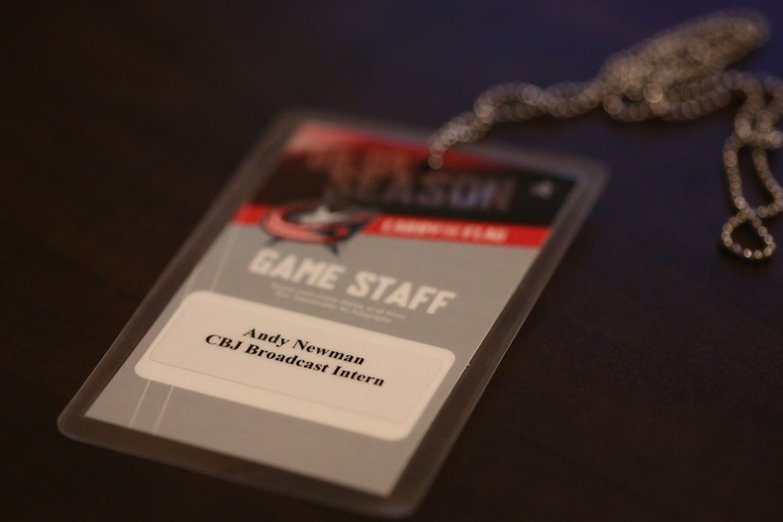
My life with the Columbus Blue Jackets from 2007-2010
Originally posted on The Cannon at SB Nation.
It all started in October 2007. I was a sophomore in college, at a small, private liberal arts school in Columbus studying Communication with a focus in radio, television, and film studies.
I had interviewed for an internship and pretty much got an offer on the spot – I was soon to start as a marketing intern with a new local cable channel that was dedicated to sports programming. I would be doing general intern stuff – more like a street team member than anything – but what did I know?
Then, she quit. My boss, and advisor for the internship which included two other students in the program, that is. Just like that. No email or explanation. I never heard from her again. So I did the only logical thing a 19-year-old would do in that situation – I quit, too. No one knew what they were doing, and they had no idea what to do with the abandoned interns.
Quitting was one of the best decisions I've ever made.
I had no plans on what was next, but I wasn't too concerned. I had 5 semesters left to get that internship thing figured out. Suddenly, an email popped up in my inbox of the terrible Windows Outlook system forced upon me by my college.
It went something like this: "The Blue Jackets are looking for a video intern. Are you interested?"
Well... it actually started before October 2007. In the early years of the newly mintedColumbus Blue Jackets, I would go to a game or two a year. I would usually go to a game around my birthday, either with my mom or my girlfriend (now wife, and we've kept the streak alive). We'd see the big games – Toronto, Detroit, Chicago... but by every definition, I was a casual fan. This changed in 2006, when I watched the Winter Olympics and fell in love with hockey. I remember, in particular, enjoying the way Team Sweden played. I remember liking not just the skill guys, but also Freddy Modin andSammy Pahlsson. This is also why, to this day, Henrik Lundqvist remains one of my favorite players.
So, the hockey bug bit me in 2006. I started following the Blue Jackets a lot more closely from that point forward, and made some friends in the community. In June 2007, the NHL Draft was coming to town. A friend I had connected with happened to be good friends with Jeff Rimer, the Blue Jackets television play-by-play commentator. Since he knew I was into broadcasting, he asked Rimer to call me. We chatted for maybe 10 minutes. I could not tell you what we talked about, I was simply beyond excited that he would take the time to talk to me. He told me to introduce myself in person if I would be at the Draft. These are the stories you don't hear about in the news, but are the truth to what makes sports so special.
I was at the Draft, and I met Jeff Rimer, and the Blue Jackets drafted my favorite player (Jake Voracek – to this day, I still follow Mike's prospect recommendations, and his favorites tend to be my favorites). From this point forward, I was a die-hard Jackets fan.
So in October, when Director of Broadcasting Russ Mollohan asked me why I was interested, my answer was the honest to God truth: I had followed hockey passionately for almost two years, and loved the Blue Jackets. I got the position, and was quickly put to work.
The National Hockey League was, I believe, the first major sports league to get serious about online video. Every team was tasked with putting good content up, and the Jackets didn't waste any time. Together, with our team of interns that started at three people, we worked with the Blue Jackets Multimedia Manager (during my years with the team) Ryan Mulcrone, to create video content every day. We launched Jackets TV with a little bit of a plan (at least that I was ever provided) and a lot of hard work.
Rather than recount my day-by-day experience that I barely remember, I'll touch on a few moments and stories that stick out in my mind. Although I started as an intern in the fall of 2007, I actually stayed on for three seasons, which yes, is completely unheard of as an intern. But it allowed me to meet a lot of people, experience a lot of cool moments, and I worked a part-time job elsewhere so they didn't need to pay me (they probably didn't want to pay me, had it been an option). Yes, I was also a full-time student, and I did graduate in four years.
These stories being sparked by the news that George Matthews is stepping down from his post as the voice of Blue Jackets radio, I'll start there.
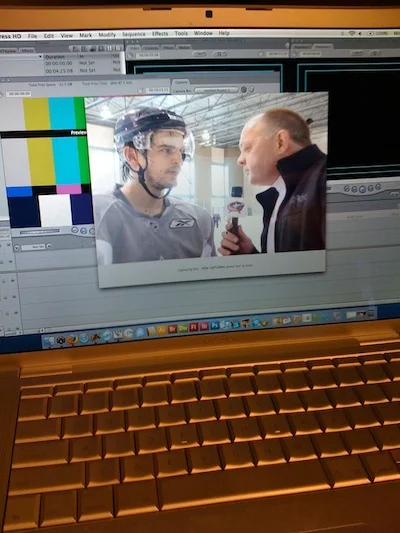
On a college radio station in Columbus. On a good night, we had probably 20 listeners. I, along with fellow Blue Jackets interns and communication students Mike Ferko andCody Leist, hosted a sports talk radio show on our (*ahem* award-winning) college radio station. Sometime in 2009 or so, Mike or Cody asked George if he'd join us on our radio show. And he did. He showed up to the basement of our communication building and, for some amount of time that I can't remember, chatted with us about hockey and the Blue Jackets. We may have even been talking playoff hockey, that being the year and all. He didn't owe us anything. But he joined us with the same enthusiasm and energy that he brought to the Blue Jackets radio booth every single night. And for that evening, I was right alongside him.
Getting recognized. By far, the coolest memory I have from my time with the team was the day Rick Nash recognized me in public, approached me, and chatted with me for a moment. Sorry if that sounds braggy, but, well, it happened. It sucks when any player gets traded, even worse when they ask for a trade. Part of me is glad Nasher didn't get to hoist the Stanley Cup in his first season after leaving Columbus, but most of me will remember him for the down to earth, nice guy that he is, $62,400,000 contract and all.
The people you meet. Hockey is the greatest sport on earth, and I believe a lot of it has to do with the great people that make up the sport. Cody and I had the opportunity to interview Chris Chelios on the night he was called up by the Atlanta Thrashers at age 48 and played against the Jackets. Our feature made it on the front page of NHL.com.
Blackhawks radio broadcaster John Wiedeman sat down and had a conversation with a couple of us after practice one day, providing encouraging words and just all around making us feel like we belonged there.
I stood near Wayne Gretzky.
The places you go. My least favorite place, by far, was in the rafters of Nationwide Arena. I'm not sure if I had a choice or not, but if I did, I should have given a little more push back. We were doing a video about the Pepsi Power Patrol... somehow my name got the call when it was time to film the dropping of the "Chipotle chutes." I was never scared of heights until that day. Just hope the team doesn't score a goal and the cannon goes off while you're up there.
One of the best places is being on the bench during practice. You can't beat it. But, when you're filming an interview and have your back turned to the ice, you just have to trust a puck won't come zooming at your head. Occasionally they'll be flipped near you by the funny guys on the team.
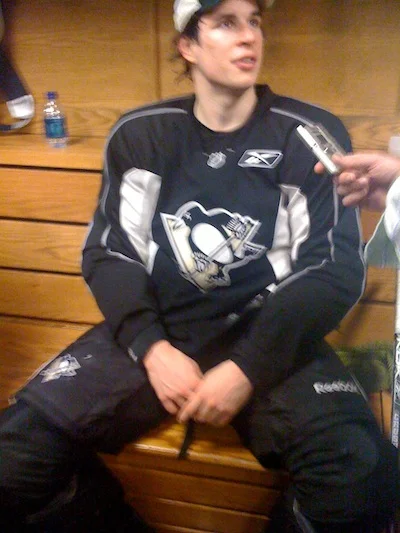
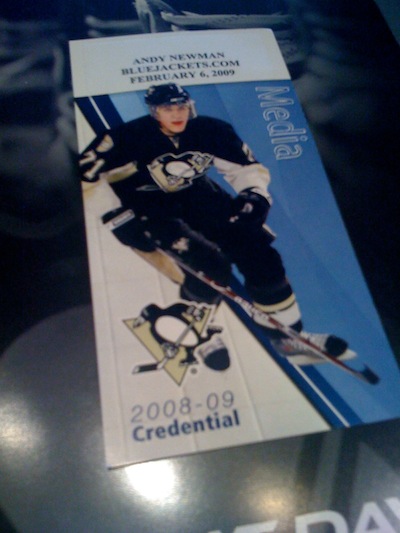
Another place that sticks out is... Pittsburgh. Mike and I had the chance to travel to the Steel City to cover an away game. Well, more like we begged, stayed at Mike's place on the border of Ohio and Pennsylvania, and drove an hour each way on game day just for the chance to work. This was in the Igloo, and I'm glad I got to see a game there before it was torn down. I do believe we had to walk across a wooden plank to get to our area in the press box, though. I stood close enough to Sidney Crosby to touch him without stretching my arm.
And, of course, "At Home." We did a video series our first year that involved going to players' homes, filming a quick tour and chatting with them about life away from hockey. I personally got to cover Jared Boll and Kris Russell's shared apartment and Dan Fritsche's Clintonville condo. I got to play NHL 08 with Boll and Russell, and some prospect who had just been called up from Syracuse brought them both lunch. (Derick Brassard)
It's not all good. It would be a disservice to only talk about the highlights. Being an intern is hard work. While I was relatively fortunate in that, as an intern, I had a hands-on role in creating daily video content for the team, the fact remains that I worked for free for three years. (There were some great perks, many mentioned above, others that I won't.) I gained a ton of great experience, but it didn't exactly play out how I had hoped in the end.
The team that runs the website, digital, and social content are worked harder than anyone but the players on the ice. Our video content included a few mainstays: practice coverage, game day previews, and post-game coverage including the coach's press conference and player interviews. Morning coverage, for quite awhile, included a segment with a member of the coaching staff breaking down the previous night's game. This meant being there and prepared by 7 or 8am (I'm not a morning person, so it was all a blur), so we could film before the coaches got to work on that day's tasks. Post-game coverage meant filming and editing videos of at least 2-3 player interviews (fewer if they lose, more if they win), and having that published before we left for the night. Games end at 9:30pm. It takes, at minimum, two hours to complete all the necessary work. You do the math. Add another 30 minutes if the game goes to a shootout.
Thankfully, we always had at least three interns, so usually the person who stayed late wasn't the same one who was in first thing in the morning. But it happened. As for the full-time employees who were our supervisors? They were there, every day without fail, even when the players got a day off.
Working in sports seems glamorous until you work in sports. Yeah, I got to meet Rick Nash, but I had no personal time for the better part of three years. At least I got to work with the players, coaches, and higher up staff on a daily basis. Imagine working in sales.
And how I mentioned it didn't end the way I wanted? Yeah, that one took awhile to get over. Being an intern for three years in a role that so many teams were beginning to hire for, I figured I was a shoo-in to get a job in that capacity. That's all I wanted.
After the final year of my internship in 2010, college graduation, and getting married, I started calling, emailing, and applying. I talked to someone with the Anaheim Ducks and tried to work a potential connection to the Washington Capitals from someone I knew well enough in the Jackets organization. I did everything I could think of to get a job with the Chicago Blackhawks – me and thousands of people over the last five years. (Team loyalty is a weird thing when you're trying to get a job.) Of course, I wouldn't be here right now if any of that proved to be successful.
The hardest blow was later that summer. Another email, almost perfectly timed, much like the one I received three years prior.
Paraphrased from someone with the Jackets: "We have approval for one full-time position. Let me know if you're interested and we'll schedule an interview."
It had to be between me and one other intern, who had continued volunteering his time over the summer, even though he had graduated as well. It had to, right?
Don't be silly. This is pro sports. The job went to someone whose relative works with the team. Looking back on some old emails, I'm not sure I actually even got my interview.
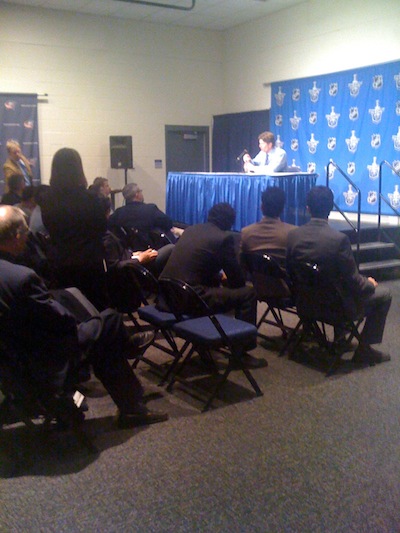
The good people. More than anything else, you tend to remember the really great people and singular moments with those people. I already mentioned Mike and Cody, with whom I have many more great memories and times forgotten. There was also Brittany Gerena, who became a close friend outside of the Blue Jackets. She went from "The CW Star" to "Britt" in an instant, because she's never met a stranger. Ryan Mulcrone, who still feels like the older brother I never had. Oddly enough, we ran into each other in Detroit in Joe Louis Arena, completely by chance, in October 2011. My wife and I made a pit stop to catch a Jackets game on our way to Windsor.
Other staff that were always supportive and friendly were Russ Mollohan and former Manager of Communications Ryan Holtmann. I've already mentioned what great guys Rick Nash, George Matthews, and Jeff Rimer are. Some others that come to mind, who deserve all your praise for being genuinely good people on and off the ice: Ken Hitchcock, Gary Agnew, Ole-Kristian Tollefsen, Manny Malhotra, Jason Chimera, Antoine and Karen Vermette, Jody Shelley, Larry Larson, and Mike Todd. I'm sure I'm forgetting many.
There was also one more chance connection that relates to this very blog. Donnie Clark, who was an intern, had an older brother. Clint Clark wrote for The Cannon right when or shortly after Mike started the blog. I started writing for it in July 2008. We were hosted on Blogger at the time, but the only evidence we existed before is on the Way Back Machine.
I always talked to Mike about sharing my experiences, since I had such a unique perspective. But, being involved with the team, I was always conscious to limit my involvement with the blog during the season. I usually stuck to things like covering the prospect camp during the off-season and the free agency period that starts on July 1st. Maybe that's part of why I like the start of free agency so much – it was the one thing I was always free to talk about, because I never had any connection with the team during the summer.
I'm far enough removed now that most of the people I knew are long gone. But with the news that Matthews is leaving, a lot of memories flooded back. I had to write some of them down before I forgot them.
Danny Boyle’s 15 Golden Rules of Moviemaking ⚓
4. FILM HAPPENS IN THE MOMENT • What’s extraordinary about film is that you make it on the day, and then it’s like that forever more. ... It changes every time you watch it: Different audiences, different places, different moods that you’re in. The thing is logically fixed, but it still changes all the time. You have to get your head around that.
What everyone's getting wrong about Google Glass (Possibly even Google)
Excited as I was to be invited to Google's private Explorers program, two realities quickly set in: I still needed to pay full price for the privilege to test Google Glass, which comes in at a cool $1500. Even if I came up with the money, I'd still have to foot the bill for traveling to New York City to pick up the Glass in person. Yeah, right.
While I can't wait to see how Glass can shape and augment our interactions with technology and the world around us, there are some understandable concerns that come with wearing a device on your face with a camera, always-on Internet connection, and location tracking. Chief among the concerns are privacy and etiquette.
The most common argument people fall back on: "I don't want to sit down with someone at dinner who is wearing Google Glass. It's creepy and inconsiderate."
Google has time until Glass is widely available, and they have time to determine how to market it. If it is marketed as a device you put on in the morning and take off before bed, they've already failed. If they let the thread of thinking that it's an accessory you should wear at the dinner table continue to run wild, it's doomed to the same fate as the Segway and Bluetooth headset.
Most people consider it rude to wear sunglasses indoors. Yet when I worked in retail, there was always someone, inside, talking to me one-on-one while wearing their sunglasses. That's a jerk move. Just like taking up two parking spaces is a jerk move. Glass indoors or in a personal setting should be regarded similarly.
But let's also get over the notion that you have privacy in public. People take pictures with their smartphones and post them to Instagram or Twitter or Facebook without asking you. Have you ever seen a hidden camera show? People have been wearing glasses and secretly recording others for decades.
There's a smart conversation about Glass and some of the real issues on an episode of The Talk Show with John Gruber and Marco Arment. Marco brings up the point that older generations may not get it, like older generations may have been uncomfortable with the idea people were snapping pictures with their phones when it was new. That doesn't make it inherently wrong, just different. The teenagers of tomorrow may not blink an eye.
You wouldn't expect someone to sit down to dinner with sunglasses on their face. Maybe we should also have the same expectation for Glass. The real utility lies in its value while in transit, at an event, or on a trip, where having your hands free but maintaining the ability to have additional information available or to take a picture will improve the experience. There's nothing wrong with that.
The world is not a messed up place
The world is not a messed up place. It's a great place full of wonder and a lot of really good people. There are just a few messed up people that want to ruin life for the rest of us.
Don't let those few messed up people get all your attention, even if it's what the media glorifies.
Think of the first responders. The nurses, doctors, and firefighters who take care of us. Think of the love and support from the people you care about, and all the other kind and special people around you. The teachers who expand our worlds and artists who give it color.
Think of the little old lady driving too slowly on the highway – to make sure she arrives safely to see her grandchildren. Think of the worker who picks up your trash – without fail, every week.
No, the world is not a messed up place.
Our world is a wonderful place.
Don't ever forget that.
Don't ever let them take that away from us.
How much does video production cost?
It can be difficult to determine an appropriate price for a video production budget. As someone seeking video production services, you may have no idea where to begin.
I found an article the other day that goes into detail about many of the specific areas of video production, and just how they can affect the overall budget. For as much detail as it delves into, it doesn't cover certain things like: If you want a video made during a busy season (a Summer wedding); or where you plan to use the video (television commercial or a blog post). Nonetheless, it's a great read to get a better perspective on where money can be spent on a professional video production. It's up to you what to spend (or charge), relative to the quality you want (or can provide).
The best point, to me, was near the end:
Share your budget
Every business has a budget and yet most businesses are reluctant to share budget figures hoping they will get an amazing deal if they don’t disclose anything. I’ve been on both sides (client and agency side) and I always had better results when I said "Here’s my budget, here are my business objectives, what can you do for me?" If you don’t declare a budget then the production company will have to guess at a budget. (I recently lost a job because the budget I guessed at was too high – even though the client really liked the concept that I had proposed. Does the company that guesses closest to your undeclared budget win?)
Anyone who runs their own business knows the many costs that go into delivering a service. Whether it's actual time, experience, people, or equipment cost, it adds up quickly. The only way to better understand budgets and why things cost what they do is to have open communication.
Why I won't give up on my dream
"The first half of each new idea is the last half of the previous idea."
I spent every day of the last two months thinking about my next project. I started working on a few different things, when finally a combination of old ideas reformed into something new. Today is the first day I'm sharing that project - Weekend Wonder.
A woman who recently lost her job meets a man at a hotel and their serendipitous first date leads to robbing a convenience store.
Earlier this year my first feature film project failed to get off the ground. I'm sure there are thousands of hopefuls who could say the same thing right now.
What matters most is execution, not ideas. You can have all the ideas in the world. If you can't put those ideas into motion, if you can't have something to show for your ideas, why should anyone care about them?
Weekend Wonder is a short film project. Why a short? Money. Hopefully one day I can expand on the characters and the ideas in the film to create something larger. Think of it as an prologue to what will eventually, hopefully, be my first feature film.
Today, you can get involved on Kickstarter.
Why Kickstarter?
I thought about this for awhile. As I mention on the Kickstarter page, failing publicly is hard, and I've failed more than once. And I definitely don't want to be seen as begging for money.
“Success is going from failure to failure without losing enthusiasm.”
– Winston Churchill
But a couple simple facts brought me back one more time (likely for the last time).
People out there believe in me. When things aren't going well, it's easy to lose sight of this. But there are people who want me to succeed, and giving them a chance to get involved in the process and offer a couple dollars to help me out is a really unique experience. It also pushes me to work even harder knowing that there are people counting on me.
I can't do this alone. I've done projects with no money for the last ten years. To take my work to the next level, like I did with Portrait, I need the chance to use real props, real locations, and to be able to afford things like really great music. In film, that all adds up to what is called production value. It's a major part of what separates the good from the great. I've worked a long time to improve my skills, and I continue to improve every day. But no amount of practice or skill will enable me to afford all of the expenses that come with making a film on my own.
I shouldn't be scared of failure. This is the last thing I keep reminding myself. Too many people start the race and get too scared or too frustrated. They come up with excuses. They have a million ideas but don't follow through on any of them.
Success in a creative field is a marathon, not a sprint. If I fail, then I fail today, not forever. Not trying means I don't even get a shot. I'll take my chances.
The thing nobody tells you
“Nobody tells this to people who are beginners, I wish someone told me. All of us who do creative work, we get into it because we have good taste. But there is this gap. For the first couple years you make stuff, it’s just not that good. It’s trying to be good, it has potential, but it’s not. But your taste, the thing that got you into the game, is still killer. And your taste is why your work disappoints you. A lot of people never get past this phase, they quit. Most people I know who do interesting, creative work went through years of this. We know our work doesn’t have this special thing that we want it to have. We all go through this. And if you are just starting out or you are still in this phase, you gotta know it's normal and the most important thing you can do is do a lot of work. Put yourself on a deadline so that every week you will finish one story. It is only by going through a volume of work that you will close that gap, and your work will be as good as your ambitions. And I took longer to figure out how to do this than anyone I’ve ever met. It’s gonna take awhile. It’s normal to take awhile. You’ve just gotta fight your way through.”
– Ira Glass
Hire talent, not years of experience
I came across a post by Gilles Leblanc that struck a chord with me:
"I can understand this practice from a recruiter’s or HR’s point of view. It is difficult to gauge the skill level of something you have no clue about and you want to filter out as much candidates as possible before having them for an interview. But I do not feel the practice is worthwhile, it’s just lazy."
So often I see job descriptions that say "7-10 years experience with social media" when "social media" as we know it today really came to be in the last five years. Or a job description that wants 5+ years of experience for an entry-level position.
It's really not that complicated. Smart companies hire smart people. Do you want someone that can satisfy a check box, or someone that you can teach a new technology, program, or concept to within a few hours of training?
A more eloquent way to say, "You get what you pay for."
"The bitterness of poor quality remains long after the sweetness of a low price is forgotten."
— Benjamin Franklin
Microsoft: You're doing it wrong
Microsoft has a new initiative offering cash to any developer that submits a new app for Windows 8 or Windows Phone, The Verge reports.
How much cash, you might ask? $100. Oh, but you're eligible to receive up to $2000. If you submit 20 unique apps, ten for Windows 8 and ten for Windows Phone. Yeah, right.
But this is nothing new. BlackBerry guaranteed at least $10,000 to developers, while Nokia has launched similar campaigns in the past.
Apparently meant to spur some type of gold rush, yet it completely misses the mark. Why would someone take the time and money to develop for Windows Phone? Does the promise of $100 really change that? Does a developer who is going to spend months developing an app, and subsequent months or years supporting that app, really get excited about $100?
Meanwhile, Android is attractive in terms of market share and the wide range of devices it supports. iOS has the highest benchmark for quality and what you want: customers that will pay good money.
When Apple launched the App Store in 2008, they partnered with KPCB to launch iFund, an investment of a guaranteed $200 million to support app development.
If you're going to bother doing it, at least do it right.